
Having recently passed my Extra exam, I (naturally) have started getting back into Amateur Radio. I bought myself a BTech UV50x2 (and before everyone hates on me for buying BTech, I’m working on a college student budget), and a mag mount antenna for my truck, and worked some of the repeaters in El Paso and the Permian Basin. When I was back at home, my first instinct was to put up my HF antenna, and start playing around with HF again.
My HF antenna is a G5RV Jr, and it has served me well in the past. At my old location, I was able to hang the antenna in a tree, drape the ladder-line almost straight down, and tune the antenna with my internal tuner on 40m, 20m, and 10m. I didn’t test the other bands, because I really only wanted to work these three. And, like I had hoped, I had no complaints. I was able to work many different locations, and could even get some DX if the conditions were okay enough. However, I had to go off to college, and that marked the end of my ham radio fun for a little while.
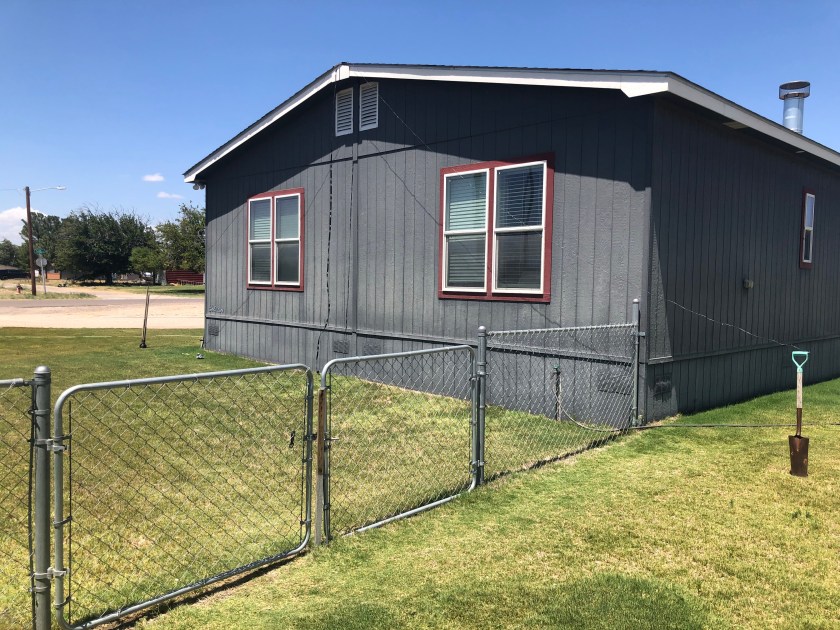
My first non-ideal antenna situation is what I am presently operating. The same old G5RV Jr, except now it is mounted on the peak of the house and draping down. I tried several different configurations before I found something that works. A little context, there is a metal fence near one of the elements, and another large metal fence about 25 feet from the base of the house, hence the non-ideal situation. I wanted to get away with a non-permanent solution, since I will be leaving soon anyways. My first attempt had me just draping the elements along the edge of the roof, and having any excess just dangle from the edge. I strung it up, went inside, and couldn’t tune it on 40m. I experimented with several different configurations, but still couldn’t get it to tune on 40m with the elements strung on top of the roof.
Instead of giving up, I pressed on. My next idea was to mount the peak of the antenna on the peak of the roof, and use some sort of stake in the ground that I could easily attach the antenna ends to, and could remove quickly if needed. I still had the problem with the two metal fences, but it couldn’t hurt to try it out. I started with an inverted-V with the elements folded in toward each other. A posthole digger and a small spade held the ends of the antenna in place. This again did not work, likely because the ladder line is now not at a 90 degree angle with the elements.
Not wanting to get near the metal fence, I took one element and began moving it closer and closer toward the side of the house. And, to my surprise, it finally tuned! At this point I decided it wasn’t worth fixing it if it wasn’t broke, and went inside to play. The next day, however, I wanted to do some more experimentation to see if I could make the situation work even just a little bit better.
Instead of having an asymmetrical dipole, I tried my hardest to make it completely even on both sides. Still an inverted V, but without any other weird folds or bends that would screw up the radiation. I ran one element as high and far away from the fence as I could without bending the element inward, and left the other one in its previous position. I now had something that looked like an actual inverted V dipole, and I was ready to try it.
I went inside and found that, unfortunately, it did not tune on 40m. My SWR was right around 4:1, so there must be some way to make this thing work! Well, I found that if I reduced the output power to 5 watts, the thing would actually tune! I guess that having less power reflected back to the transmitter makes it a little more willing to work with me. I cranked it back up to 100W, and managed to make contact with someone from the Czech Republic, approximately 5,500 miles away! If that doesn’t give this antenna the seal of approval, nothing will. Below is an image of the antenna setup.
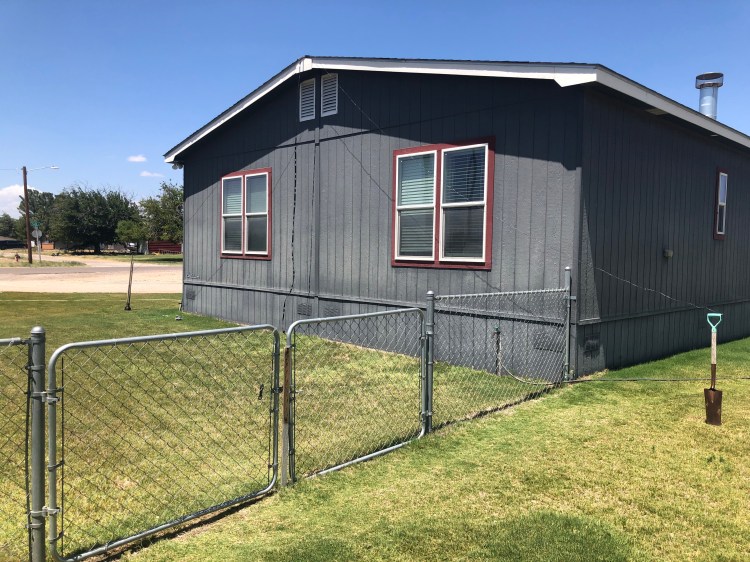
Surprisingly to me, I found that, even though the house covers the east side of the antenna, it still radiates fairly well toward the east. In that same night, I spoke to someone from College Station, and got a 5-9 signal report. When I was putting up this antenna, I was resigned to only hearing people west of me, so this was a pleasant surprise.
Long story short, don’t talk yourself out of putting up an antenna because you don’t think it will work. You never know what will actually happen until you try, and you might be pleasantly surprised. This doesn’t mean that you can put a hanger in your antenna port and expect it to work, but that even a non-ideal antenna is still an antenna. I myself will be moving to an apartment, and I will need to figure out my antenna situation. I’m certainly not going to be able to put up any killer antenna, but I will work with what I have, and hope for the best. And who knows, maybe it’ll perform better than I expect!
 AXElectronic